In 2020, emergency remote teaching reshaped classrooms overnight. But in 2025, online learning is no longer just a response to crisis—it’s a strategic cornerstone of modern education. Institutions, educators, and learners worldwide are adapting to a digital-first model that’s more personalized, scalable, and data-informed than ever before.
The Pandemic Sparked a Revolution in Education. Now, in 2025, That Revolution Is Evolving into a Long-Term Transformation
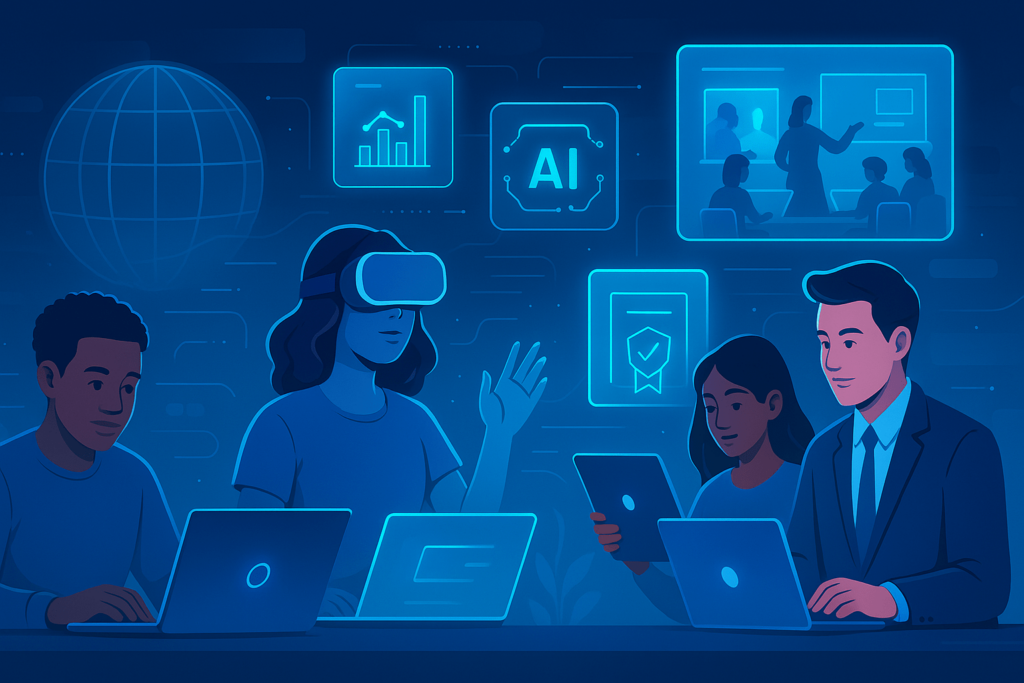
This evolution isn’t just about convenience. It’s about inclusion, accessibility, and relevance in a fast-changing world. Whether you’re a student, teacher, instructional designer, or education leader, understanding what’s shaping virtual education in 2025 is essential to stay ahead.
Why Online Learning Continues to Grow in 2025
Flexible Access and Global Reach
Today’s digital learners span continents and time zones. Online education enables anytime, anywhere access, making it easier for individuals juggling careers, families, or geographical limitations to pursue education.
Demand for Lifelong Learning and Upskilling
The half-life of professional skills continues to shrink. As automation and AI evolve, professionals are turning to online certifications, microdegrees, and short courses to stay competitive and future-proof their careers.
Accessibility, Affordability, and Personalization
Digital learning reduces costs associated with commuting and materials while increasing access to world-class instructors and resources. More importantly, platforms are adapting to each learner’s pace and style, making education more effective than ever.
Top Online Learning Trends Shaping 2025
1. AI-Powered Personalized Learning
Adaptive learning platforms now use artificial intelligence to analyze student behavior and performance, customizing content, feedback, and learning pathways in real time. These systems detect when learners struggle, recommend revision content, and even predict outcomes to help educators intervene early.
2. Microlearning & Nano-Credentials
Short-form, skill-specific content has exploded in popularity. Learners now prefer bite-sized video lessons, quizzes, and modules they can complete on the go. With the backing of nano-credentials, these mini-courses offer real value in hiring and career advancement.
3. Immersive Learning with AR/VR
Augmented and virtual reality are no longer futuristic—they’re functional. Learners can explore historical events in 3D, practice surgeries in simulated labs, or attend virtual chemistry classes with real-time interaction. These tools improve engagement and comprehension through hands-on, visual learning.
4. Collaborative & Social Learning Tools
Learning is becoming more community-driven. Cohort-based courses, real-time discussion forums, and peer review systems help recreate the interactive spirit of physical classrooms. Platforms like Discord and Slack are even being used as informal virtual campuses.
5. Learning Analytics for Educators
Educators now have dashboards offering deep insights into learner behavior, from drop-off points in video lessons to time spent on assignments. This data enables more responsive instruction, tailored remediation, and curriculum optimization.
6. Rise of Mobile-First Learning
With mobile traffic overtaking desktop globally, learning platforms are prioritizing mobile UX. Lessons are optimized for small screens, videos are subtitled and compressible, and quizzes are gamified to keep mobile learners engaged and active.
7. Human-AI Collaboration in Teaching
Far from replacing teachers, AI now supports them with auto-grading tools, personalized feedback generators, and AI teaching assistants. These tools free up time for educators to focus on mentoring, coaching, and deep instructional design.
Challenges to Address in the Future of E-Learning
Digital Divide and Access Inequality
While online learning is growing, not all learners have equal access to devices and high-speed internet. Bridging this gap remains a global priority for policymakers and institutions.
Engagement and Motivation
Remote learning can feel isolating. Maintaining student engagement in virtual environments requires intentional design, interactive tools, and consistent communication.
Standardization and Quality Control
As the number of platforms and providers grows, so does the variance in quality. The education sector must work toward standardized benchmarks, accreditation systems, and content quality assurance to maintain credibility.
What It Means for Learners, Educators, and Institutions
For Learners
Education in 2025 is self-paced, stackable, and skills-focused. Students must be proactive, digitally literate, and comfortable navigating online platforms and resources.
For Educators
Teaching now requires digital fluency, comfort with analytics, and the ability to create engaging content across multimedia formats. Lifelong learning applies to educators as much as students.
For Institutions
To stay relevant, institutions must invest in scalable edtech infrastructure, train faculty in digital pedagogy, and design inclusive, flexible programs that meet diverse learner needs.
Conclusion
Online learning in 2025 is not a temporary adaptation—it’s the new foundation of global education. As technology becomes more intuitive and learners demand more flexibility, the virtual classroom is transforming into a dynamic, immersive, and personalized environment.
Those who embrace the shift now will shape the classrooms of tomorrow.

Berbagi cerita seputar karier, freelance, traveling hemat, dan pola hidup sehat
ala anak muda Indonesia. Di Kiddie Joy, gw nulis tutorial praktis biar lo bisa
ngerjain hal-hal kecil yang bikin hidup lebih ringan, mulai dari rapiin keuangan
freelance, jaga kesehatan di tengah deadline, sampai ngeplan liburan tanpa bikin
dompet jebol.